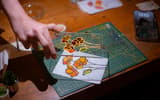
What is included in the stained glass painting workshop?
Materials at your station
Your station is set before you sit down: a small piece of clear flat glass pre-cut into a circle or a square, a wooden tray of paint pots in several colours, fine brushes lined up on a paper towel, a stack of pattern cards on the side. The glass is wiped clean of any oil. The team picks the design with you. Some come in with a clear idea, some flip through the cards for ten minutes. There is no rush. As one guest from the UK put it after a session last May, the workshop was "a perfect thing to do on a cloudy afternoon."
Stained glass painting workshop included paints and brushes
On the table at every place setting: a pre-cut glass piece (round, square, or hexagonal), a tray of stained glass paints, three brushes of different sizes, a damp cloth, a pattern reference card, an apron, and a small sketching pad for practice. Aprons are optional. The team hands them out at the door. As a guest from Australia wrote afterwards, the team "had great recommendations with best outcome."
The painting process
Pick your pattern card. Sketch a draft on paper to see how the colours sit together. Trace the outline onto the glass with a thin black liner; this dries quickly and acts like the lead lines in a real stained glass piece. Pick up a brush. Fill each section with one colour at a time. Wait two minutes between sections so the wet edges do not bleed. Step back at the halfway point and look at the piece from arm's length. Make any final calls before the last sections. An Australian guest: "our host helped with choosing the correct colours."
Stained glass workshop istanbul pace and design choice
Will the stained glass workshop istanbul session feel rushed? No. The first ten minutes are practice on paper. Once you feel ready, the glass starts. Will you be able to choose a traditional Turkish pattern? Yes; the team has several, from Iznik tile motifs to Ottoman tulip designs. What about your own pattern? That works too: send a sketch in advance and the team pre-cuts a glass piece to fit. A guest from the Netherlands put it this way: "incredibly fun workshop, with very friendly staff and great guidance!"
The setting and session length
A session runs about ninety minutes from sit-down to leaving. The first twenty go to the design pick and a quick paper practice. Painting itself takes around fifty minutes; it's the longest stretch and where most guests find their rhythm. The last twenty are for letting the piece dry, packing it up, and any leftover questions. The studio fits six to eight stations around a long worktop, with north-facing light through the day. As a guest from Qatar put it after a session: "friendly staff, relaxed setting, i left to wander around while my painting dried." The team stays past the ninety-minute mark for anyone with more questions.
The piece you take home
A guest from New Zealand wrote afterwards that the workshop was "one of the best things we have done, very therapeutic." The painting motion is small and repetitive; it pulls focus inward. A mother and her nine-year-old daughter from Germany did the session last October; the daughter finished a few minutes early and watched the room from her chair.
What is not part of the price
The standard rate does not cover transport from your hotel, a meal at the studio, a frame for the finished glass, or a second glass piece. Aprons and brushes stay at the studio after the session. The piece that goes home is the one you painted; the team wraps it in protective paper for the way back. A second glass piece can be arranged on a private booking. One guest from Greece asked us last summer for a matching pair so each member of her family could paint one. Easy to plan in advance.
Private versus open session
Private booking: the studio holds for one party only. The team focuses on your design and pace. Works for a couple, a friend group, or a parent and a child. Open session: the room shares with one or two other small parties. As one UK guest noted, an open day can also turn quiet: "I got lucky on this occasion as I was the only one doing the stain glass painting so I had a one to one session."